History
Early origins: 1947–1958
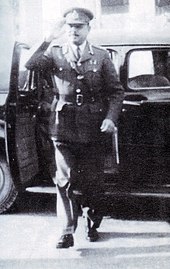
General
Ayub Khanarriving to take command of the Pakistan Army in January 17, 1951
The Pakistan Army came into its modern birth from the division of the
British Indian Army that ceased to exist as a result of the
partitionof India that resulted in the
creation of Pakistan on 14 August 1947.
:1–2[2] Before even the partition took place, there were plans ahead of dividing the British Indian Army in different parts based on the religious and ethnic influence on the areas of India.
:1–2[2]
On 30 June 1947, the
War Department of the British Government in India began planning the dividing of the ~400,000 men strong British Indian Army, but that only begin few weeks before the partition of India that resulted in violent
Religious violence in
India.
:1–2[2]Major division of the army was overseen by Sir
Chandulal Madhavlal Trivedi, an Indian
civil servant who was influential in making sure that ~260,000 men would be transferred into forming the
Indian Army whilst the remainder balance going to Pakistan after the
independence act was enacted by the United Kingdom on the night of 14/15 August 1947.
:2–3[2]
Command and control at all levels of the new army was extremely difficult, as Pakistan had received six armoured, eight
artillery and eight
infantry regiments compared to the twelve armoured, forty artillery and twenty-one infantry regiments that went to India.
:155–156[22]In total, the size of the new army was about ~150,000 men strong.
:155–156[22] To fill the vacancy in the command positions of the army,
British Army officers had to be retained, which was quiet in larger number, under the command of
Lieutenant-General Frank Messervy, the first
Commander-in-Chief of the Pakistan Army.
:70[23]
Fearing that India would take over the state of
Kashmir, irregulars, scouts and tribal groups entered the Muslim majority state of Kashmir to oppose the
Maharaja of Kashmir 1947. In response to this, the Maharaja acceded to India. The
Indian Armed Forces were then deployed to Kashmir. This led to the
Indo-Pakistani War of 1947. Regular Army units joined the invasion later on but were stopped after the refusal of the C-in-C of the army, British officer
General Sir Frank Messervy, to obey Pakistani leader Muhammad Ali Jinnah's orders to move the Army into Kashmir. A ceasefire followed on UN intervention with Pakistan occupying the northwestern part of
Kashmir and India occupying the rest. Later, during the 1950s, the Pakistan Army received large amounts of economic and military aid from the United States and Great Britain after signing two mutual defence treaties, the
BaghdadPact, which led to the formation of the
Central Treaty Organization (CENTO), and the
Southeast Asia Treaty Organization (SEATO) in 1954. This aid greatly expanded the Pakistan Army from its modest beginnings.
1958–1969
The Pakistan Army took over from politicians for the first time when General
Ayub Khan came to power through a
bloodless coup in 1958. He formed Convention Muslim League which included
Zulfikar Ali Bhutto, who would later become Pakistan's first democratically elected Prime Minister. Tensions with India flared in the 1960s and a brief border skirmish was fought near the
Rann of Kutch area during April 1965. The War began after the failure of
Operation Gibraltar on 5 August 1965. On the night of 6 September 1965, the
Indian Army opened the war front to the
Province of Punjab of Pakistan; the
Indian Army almost reached the Pakistani city of
Lahore. The Indian Army conquered around 360 square kilometres (139 square miles)
[24]–500 square kilometres (193 square miles)
[25] of Pakistani territory on the outskirts of Lahore.
[26] Indian forces halted their assault on Lahore once they had reached the village of
Burki.
[26][27][page needed][28][29] The rationale for this was that a ceasefire was to be signed soon, and had India captured Lahore it would likely have been returned in ceasefire negotiations.
[27][page needed][28][29] The War eventually ended with a
United Nations (UN) backed ceasefire and was followed by the
Tashkent Declaration. According to the Library of Congress Country Studies conducted by the Federal Research Division of the United States:
The war was militarily inconclusive; each side held prisoners and some territory belonging to the other. Losses were relatively heavy—on the Pakistani side, twenty aircraft, 200 tanks, and 3,800 troops. Pakistan's army had been able to withstand Indian pressure, but a continuation of the fighting would only have led to further losses and ultimate defeat for Pakistan. Most Pakistanis, schooled in the belief of their own martial prowess, refused to accept the possibility of their country's military defeat by "Hindu India" and were, instead, quick to blame their failure to attain their military aims on what they considered to be the ineptitude of Ayub Khan and his government.
[30]
At the time of ceasefire declaration, per neutral sources, India casualties were at 3,000 and Pakistani casualties were 3800.
[31][32][33] Pakistan lost between 200-300 tanks during the conflict and India lost approximately 150-190 tanks.
[34][35]
However, most neutral assessments agree that India had the
upper hand over Pakistan when ceasefire was declared.
[36][37][38][39][40] At the end of the war the Indian army was in possession of 758.9 miles² (1,920 km²) of Pakistani territory and the Pakistan army held 210 mile² (550 km²) of Indian territory.
[41] The territory occupied by India was mainly in the fertile Sialkot, Lahore and Kashmir sectors,
[42][43] while Pakistani land gains were primarily in southern
deserts opposite
Sindh and in the
Chumb sector near Kashmir in the north.
[42] An uprising against Ayub Khan during 1968 and 1969 resulted in him relinquishing his office as President and Commander-in-Chief of the Army in favour of General
Yahya Khan, who assumed power in 1969. The 16th Division, 18th Division and the 23rd Division were raised at some point between 1966 and 1969 and the 9th Division was also re-raised during this period.
1969–1971
During the rule of Yahya Khan, the people of
East Pakistan protested against various political and economic disparities that had been imposed on them by
West Pakistan and massive civil unrest broke out in East Pakistan.
The original plan envisioned taking control of the major cities on 26 March 1971, and then eliminating all opposition, political or military,
[44] within one month. The prolonged Bengali resistance was not anticipated by Pakistani planners.
[45] The main phase of Operation Searchlight ended with the fall of the last major town in Bengali hands in the mid of May.
According to Maj. (Retd.) Agha Humayun Amin, the Pakistan Army commanders had not seriously considered an Indian invasion of East Pakistan until December 1971, because it was presumed that the Indian military would not risk intervention by China or the United States, who were generally close Pakistani allies. Maj Mazhar states that the Pakistan Army's senior command failed to realize that the Chinese would be unable to intervene during the winter months of November to December, due to snowbound Himalayan passes, and the US had not made any real effort to persuade India against attacking East Pakistan.
[48]
1971–1977
A
Pakistan International Airlines (PIA) flight was sent to fetch Zulfikar Ali Bhutto from
New York, who at that time was presenting Pakistan's case before the
United Nations Security Council (UNSC) on the East Pakistan crisis. Bhutto returned home on 18 December 1971. On 20 December, he was taken to the President House in
Rawalpindi where he took over two positions from Yahya Khan, one as President and the other as Chief Martial Law Administrator. Thus, he was the first civilian Chief Martial Law Administrator of Pakistan.
1977–1999

Two
AH-1S Cobra attack helicopters of the Pakistan Army Aviation Wing at AVN Base,
Multan. These were sold to Pakistan by the US during the
Soviet–Afghan war to help defend Pakistan against a possible attack by the Soviets.
In 1977, a coup,
Operation Fair Play, was staged by General
Zia ul-Haq and the government was overthrown. This led to the hanging of Bhutto after he was tried and proclaimed guilty of conspiracy of murdering a political opponent by Zia's handpicked judges. Zia retracted on his promise of holding elections within 90 days and ruled as a military dictator until his death in an air crash in 1988. General Mohammad Iqbal Khan served as a joint chief from 1980 to 1984 and was the Chief Martial Law Officer during that time.
In the mid-1970s, the Pakistan Army was involved in fighting an uprising in the
Province of Balochistan. Various Baloch factions wanted independence or at least greater provincial rights. The rebellion was put down on the behest of the Bhutto government but the Army suffered heavy casualties. After Bhutto was deposed, the province returned to normalcy
[citation needed] under General
Rahimuddin.
In the 1980s, the Pakistan Armed Forces co-operated with the United States to provide arms, ammunition and intelligence assistance to Afghan rebels who were fighting the
Soviet invasion of Afghanistan.
During
1st Gulf War, the Pakistan Army contributed troops for the defence of Saudi Arabia against a possible attack by Iraq. The 153 SP Air Defence Regiment deployed in Tabuk scored multiple hits on number of Iraqi Scuds
[citation needed] and provided round the clock air defence protection to Saudi troops in the area.
Pakistan sent UN Peacekeeping forces to the former Yugoslavia during the Yugoslav wars. During the war, Pakistan supported Bosnia while providing technical and military support. Approximately 90,000 Pakistani people went to Bosnia during the Yugoslav wars, accounting for 20% of the volunteer military force. The
Inter-Services Intelligence (ISI) allegedly ran an active
military intelligence program during the
Bosnian War which started in 1992 lasting until 1995. The program distributed and coordinated the systematic supply of arms to various groups of
Bosnian mujahideen during the war.
[citation needed] The ISI Bosnian contingent was organized with
financial assistance provided by Saudi Arabia, according to the British historian
Mark Curtis.
[53] Despite the
UN arms embargo in Bosnia, it was later alleged that the ISI airlifted anti-tank weapons and missiles to Bosnian mujahideen which turned the tide in favor of Bosnian Muslims and forced the Serbs to lift the genocidal
siege of Sarajevo.
[54][55]
1999–2008

A Pakistan Army soldier keeping watch at Baine Baba Ziarat in Swat
In October 1999, after the
Kargil Conflict ended with the unconditional withdrawal of the Pakistani forces from the Indian controlled peaks, the Pakistan Army overthrew a democratically elected government once more, resulting in additional sanctions being applied against Pakistan, leading to General
Pervez Musharraf coming to power in a
bloodless coup. However, this time Prime Minister
Nawaz Sharif sacked Musharraf when he was on his way to Pakistan from
Colombo. He dismissed him as Chief of Army Staff and appointed General Ziauddin Butt to that position instead, when Musharraf's plane was in the air. That was not enough, the plane was not allowed to land at the airport in
Karachi and barricades were erected on the runway. The corps commanders acted swiftly across Pakistan, particularly in Karachi and
Islamabad. Brigadiar Muzaffar Usmani took control of the airport in Karachi and arrested the then Inspector General of
Sindh Police, Rana Maqbool Ahmed. Musharraf stepped down as President in August 2008. On 30 July 2009, the
Supreme Court of Pakistan ruled that Musharraf's imposition of emergency rule was unconstitutional.
[56]
After the
September 11 attacks in the United States, Pakistan joined the US-led
War on Terror and helped the
United States Armed Forces by severing ties with the
Taliban and immediately deploying 72,000 troops along Pakistan's western border to capture or kill Taliban and
Al-Qaeda militants fleeing from Afghanistan. On the north western front, Pakistan initially garrisoned its troops in military bases and forts in the tribal areas. In May 2004, clashes erupted between the Pakistani troops and Al-Qaeda's and other militants joined by local rebels and pro-Taliban forces. However, the offensive was poorly coordinated and the Army suffered heavy casualties, while public support for the attack quickly evaporated. After a two-year conflict from 2004 until 2006, the Pakistani military negotiated a ceasefire with the tribesmen from the region in which they pledged to hunt down Al-Qaeda members, stop the "
Talibanization" of the region and stop attacks in Afghanistan and Pakistan. However, the militants did not hold up their end of the bargain and began to regroup and rebuild their strength from the previous two years of conflict.
Militants
took over the Lal Masjid in Islamabad. After a six-month standoff fighting erupted again in July 2007 when the Pakistani military decided to use force to end the Lal Masjid threat. Once the operation ended, the then newly formed
Tehrik-i-Taliban Pakistan (TTP), an umbrella group of militants based in the
Federally Administered Tribal Areas (FATA), a semi-autonomous region of Pakistan, vowed revenge and launched a wave of attacks and suicide bombings which erupted all over North-West Pakistan and major Pakistani cities, including Karachi, throughout 2007.
The militants then expanded their base of operations and moved into the neighbouring
Swat Valley, where they imposed
sharia law. The Pakistan Army launched an offensive to re-take the Swat Valley in 2007, but was unable to clear it of the militants who had fled into the mountains and waited for them to leave before taking over the valley again. The militants then launched another wave of terrorist attacks inside Pakistan. The Pakistani government and military tried another peace deal with the militants in Swat Valley in 2008. This was roundly criticized in the West as abdicating to the militants. After initially pledging to lay down their arms if Sharia law was implemented, the Pakistani Taliban subsequently used the Swat Valley as a springboard to launch further attacks into neighbouring regions, reaching to within 60 kilometres (37 mi) of Islamabad.
Public opinion then turned decisively against the Taliban terrorists. This opinion was highlighted following the release of a video showing the flogging of a girl by the Pakistani Taliban in the Swat Valley. Similar events and terrorist attacks finally forced the Pakistan Army to launch a decisive attack against the Taliban occupying Swat Valley in April 2009, after having orders received from the political leadership.
[57] After heavy fighting, the Swat Valley was largely pacified by July 2009, although isolated pockets of Taliban remained in the area.
The next phase of the Pakistan Army's offensive was the formidable Waziristan region. A US
unmanned combat aerial vehicle (UCAV)
bomb strike in FATA killed the leader of the Taliban,
Baitullah Mehsud, in August. A power struggle engulfed the Taliban during September, but by October a new leader had emerged,
Hakimullah Mehsud. Under his leadership, the Taliban launched another wave of terrorist attacks throughout Pakistan, killing hundreds of people. After a few weeks of air strikes, artillery and mortar attacks, 30,000 troops moved on into
South Waziristan. The Army eventually re-took all of South Waziristan.
In April 2012 an
avalanche struck the 6th Northern Light Infantry Battalion headquarters in Ghyari sector of
Siachen, entrapping 135 soldiers.
[58]


